
On Monday afternon I wrapped up a coaching relationship with a long-term client I've loved supporting. For these completion sessions, I typically create a detailed artifact that captures the arc of our work together, including milestones, learnings, and quotes.
I shared my screen and we read it together, scrolling slowly so he could see his transformation reflected back at him. About halfway through the document, he stopped me.
"Damn, I've said no to a lot of stuff."
In our very first session eighteen months ago, he told me he struggled with saying no, both out of habit and FOMO. But over the course of our relationship, he paused a scaling podcast, shuttered a lucrative subscription business, and started saying no to random meetings.
"I now see there's a power in being able to say no," he said. "I've claimed that. I didn't have control of it before."
I let his realization hang for a few breaths. Then I asked him, "Did you ever read The Science of Hitting by Ted Williams?"
"Many years ago. I specifically remember the batting chart with the colors."
My father showed that chart to my brothers and me once we started Little League. He grew up in the suburbs of Boston worshipping the Red Sox legend. A signed photo of Williams hung on my dad’s wall until his death in 2023. He loved talking about all things Teddy Ballgame, especially The Science of Hitting.
In the book, Williams divided his strike zone into seventy-seven baseballs, seven across and eleven high, and estimated his batting average for each one. Belt high over the heart of the plate, he put himself at .400. Down and away in the low outside corner, .230.
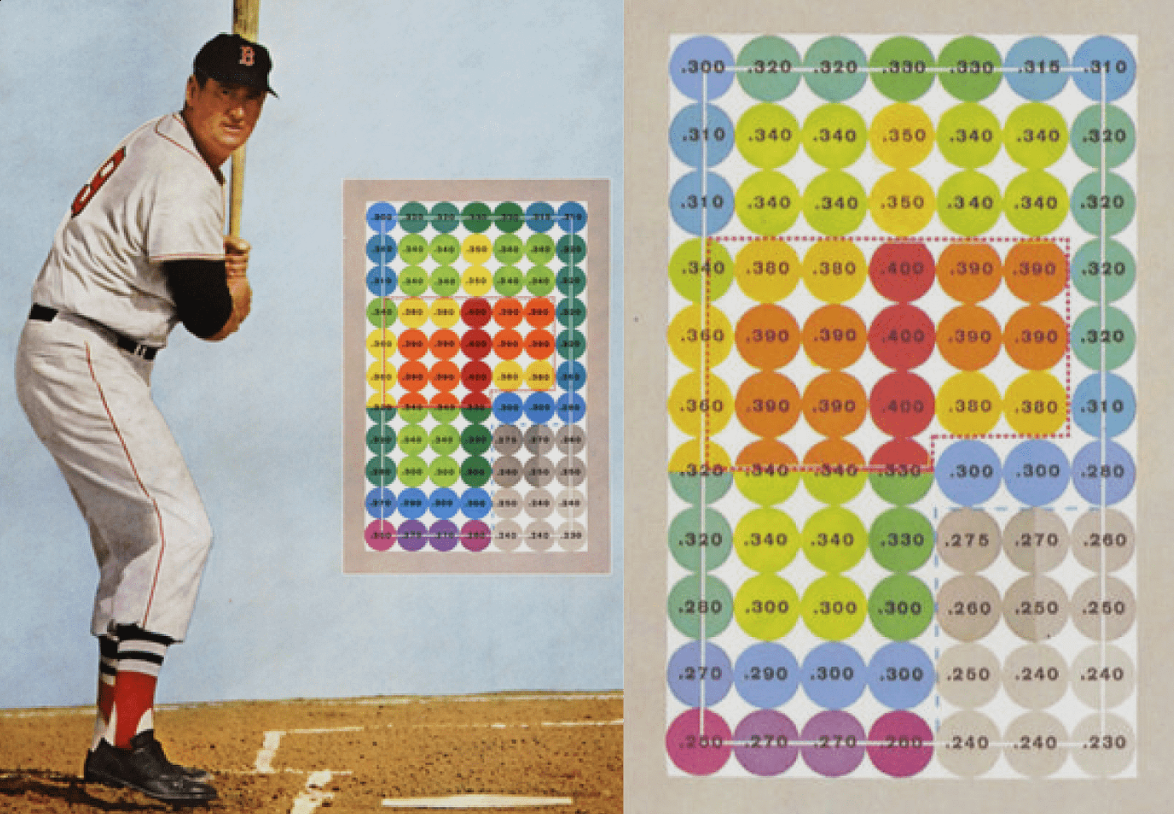
He refused to swing at the .230 pitches. Even when they were strikes, he let them go.
Williams spent nearly twenty years in the Bigs figuring out which pitches were worth swinging at and which ones to leave alone.
That's what my client had been learning, too. He eventually realized there would always be another pitch. The work for him was learning which ones were worth swinging at.
"I feel much more confident in those decisions," he explained on Monday. "At the beginning I felt like I couldn't afford to give up that potential upside in something, but now I see that I can continue to create my own upsides."
If we're patient, more pitches will inevitably come. Some will find us organically, and some we'll create ourselves. The question is which ones are worth our time and energy. This looks different for everyone. It could be a senior role at a hot startup, an angel investment in a company where a16z is leading the round, or a new product you know you could build and the market wants.
But a good pitch isn't necessarily the right pitch. What's dead center for someone else can be low and away for you, and the hard part is knowing the difference.
So how do you know the difference?
You have to take swings and pay attention to what happens.
As you get more experience and know yourself better, your strike zone evolves. Your swings are influenced by where you are in your life, what you value, what you need, what you want, and who you're becoming. They're also influenced by the realities of your life. The same pitch can be right for you in one season and wrong in another, depending on the people and commitments you're responsible for.
Over time, you start paying attention to what your swings are telling you. Not just whether you got a hit, but the effect it had on you. Did it light you up or leave you depleted? Did it fit the life you’re actually living or the life you think you should be living? Did it feel like a good use of your lifeforce? That’s how the chart gets drawn, one at-bat at a time.
I've swung at and smashed plenty of pitches that looked good from the outside. Right as I was becoming a coach, I said yes to a Partner role at Primary Venture Partners because I was being heavily recruited and the role was familiar. I left eighteen months later to go all in on coaching. In 2023, I launched a podcast, published eight great episodes, had thousands of downloads, but decided it wasn't for me at the time.
Both looked like they were in my strike zone. Earlier in my career, they would have been great pitches for me. They just weren't mine anymore, and I couldn't have known that in advance. I had to swing and step into it to find out.
All these years later, I’m still learning my strike zone. So is my client, and I suspect most of us are. There are pitches we’ll miss, those we’ll take that turn out not to be ours, and others we’ll crush. And if we’re lucky, we’ll get another at-bat soon enough.